
PlayOJO Sister Sites
PlayOJO is operated by Skill On Net Ltd under UKGC account 39326, with more than thirty active sister brands on the same Malta-based licence. The 2017 zero-wagering pioneer and OJOplus cashback mechanic distinguish PlayOJO from its siblings, and we profile each PlayOJO sister site honestly.
PlayOJO Sister Sites Comparison Table
| Brand | Our Rating | Welcome Bonus | Payout Speed (E-Wallets) | Top Feature |
|---|---|---|---|---|
| PlayOJO | 4.5 / 5 | 50 spins on Book of Dead with zero wagering | 0–24 hours | Zero-wagering pioneer since 2017 with OJOplus cashback on every spin |
| Spin Genie | 4.0 / 5 | Match welcome bonus + spins (10x wagering post-UKGC cap) | 0–24 hours | 2022-launched flagship with 5,000+ titles and modern interface |
| EU Casino | 3.8 / 5 | 5 spins on Fire Joker no-deposit + match (10x wagering) | 0–24 hours | 2009-launched flagship with 6,000+ games from 50+ providers |
| Slots Magic | 3.9 / 5 | Match welcome bonus + spins (10x wagering post-UKGC cap) | 0–24 hours | Slot-led heritage brand with extensive Pragmatic Play and Play’n GO catalogue |
| Genting Casino | 3.9 / 5 | Match welcome bonus + spins (10x wagering post-UKGC cap) | 0–24 hours | Land-based heritage crossover with Genting Live studio integration |
| Slingo | 4.1 / 5 | Match welcome bonus on slingo-format games (10x wagering) | 0–24 hours | Original slingo-format specialist with the largest Slingo Originals library |
Every site listed except Genting Casino holds a valid UKGC licence under Skill On Net Ltd account 39326. Genting Casino is profiled here as a SkillOnNet platform partner but operates under a separate UKGC licence (account 54207 per affiliate documentation including gamblingauthority.co.uk — verifiable on the UKGC public register) and as a white-label arrangement with Genting UK plc rather than directly under the SkillOnNet operator licence. Bonuses are subject to change — always verify the latest terms directly on each operator’s website before depositing. The PlayOJO casino UK welcome offer remains structurally zero-wagering even after the 19 January 2026 UKGC SR Code 5.1.1 changes, while every other Skill On Net casinos welcome offer in the network now operates under the post-cap 10x wagering ceiling. This PlayOJO review covers the broader PlayOJO sister sites portfolio and the wider SkillOnNet sister sites network under account 39326 alongside the PlayOJO product itself plus the Genting Casino platform-partner relationship.
Spin Genie – Best PlayOJO Sister Site for Modern Interface
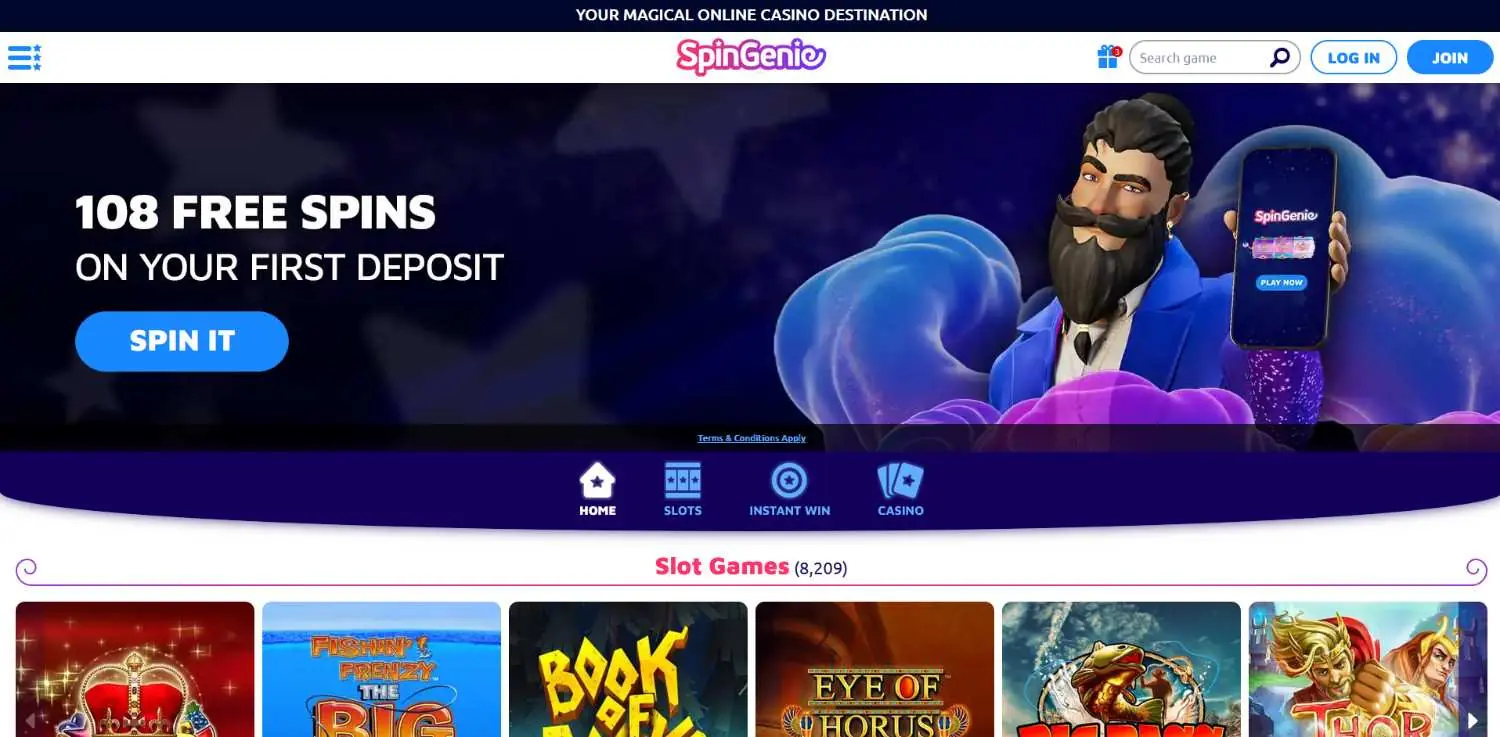
Spin Genie is the most recently-launched flagship in the Skill On Net Ltd network and the best PlayOJO sister site for players who want modern interface design with comparable library depth. Among the PlayOJO sister sites under SkillOnNet, Spin Genie is the most recent major launch. The Spin Genie sister sites group operates under the same UKGC account 39326 as PlayOJO, EU Casino, Slots Magic, Slingo and the rest of the directly-licensed SkillOnNet network (Genting Casino sits on the SkillOnNet platform as a white-label partner under its own separate UKGC licence). As a direct PlayOJO alternative on game count, Spin Genie’s 5,000+ catalogue exceeds PlayOJO’s. Spin Genie launched in 2022 as a major new SkillOnNet brand following the operator’s portfolio expansion strategy, and now carries more than 5,000 titles — broader than PlayOJO’s 3,000 catalogue. The visual identity is more minimalist than PlayOJO’s distinctive character-led branding, with a cleaner front-end designed for the post-2025 UK regulatory environment. Independent affiliate coverage including the HadesBet sister sites overview discusses comparable modern-interface UKGC casinos.
The library carries the standard SkillOnNet provider stack: Pragmatic Play, Play’n GO, NetEnt, Microgaming, Red Tiger, Big Time Gaming, Yggdrasil and Hacksaw Gaming on slots, with Evolution Gaming for live dealer content. The slot count of 5,000+ titles materially exceeds PlayOJO’s catalogue, although PlayOJO retains a more curated editorial selection. Live casino runs through Evolution with the full game-show inventory including Crazy Time, Lightning Roulette, Monopoly Live, Dragon Tiger, Mega Wheel and Cash or Crash.
The Spin Genie welcome offer follows the standard SkillOnNet wagering-attached template (in contrast to PlayOJO’s zero-wagering approach), with wagering capped at 10x under UKGC SR Code 5.1.1 post-19-January-2026. Minimum deposit is £10, maximum bet during wagering is £5 per spin, and bonus funds expire after 7 days. The exact terms depend on the active promotional code — confirm on site before depositing.
Payment methods cover Visa Debit (credit cards not permitted per UKGC 14 April 2020 ban), Mastercard Debit, PayPal, Apple Pay, Trustly, Skrill, Neteller, MuchBetter and bank transfer. Trustly withdrawals can be instant, with e-wallets clearing 0–24 hours. Loyalty mechanics run through a tier-based programme without the OJOplus cashback-on-every-spin feature that distinguishes PlayOJO.
What distinguishes Spin Genie from PlayOJO is the modern interface design and the larger raw game count. The trade-off is the loss of PlayOJO’s zero-wagering welcome and OJOplus cashback — Spin Genie operates with standard wagering-attached bonuses like the rest of the network excluding PlayOJO. For PlayOJO players who want a brand with comparable game depth but a more contemporary interface and are willing to engage with standard wagering structures, Spin Genie is the natural in-network alternative.
Spin Genie Review
| Metric | The Spin Genie Experience |
|---|---|
| Site Identity | 2022-launched flagship with modern minimalist design |
| Standout Mechanic | Cleanest front-end and 5,000+ slot catalogue (broader than PlayOJO) |
| Game Edge | Full SkillOnNet provider stack with deeper Hacksaw Gaming and Big Time Gaming positioning |
| Payout Speed | Trustly instant; e-wallets 0–24 hours |
| The Trade-Off | No zero-wagering welcome or OJOplus cashback structure |
| Best For | PlayOJO players who prioritise modern design and library breadth |
EU Casino – Top Site Like PlayOJO for Library Depth

EU Casino is the heritage flagship in the Skill On Net network and one of the most established sites like PlayOJO on operational track record. Among sites like PlayOJO under the same SkillOnNet licence, EU Casino has the longest documented history. The EU Casino sister sites group operates under the same UKGC account 39326 as PlayOJO and the broader SkillOnNet portfolio. EU Casino launched in 2009 and has been on the SkillOnNet platform for the entire history of the network, predating PlayOJO by eight years. The generic “EU Casino” name reflects deliberate positioning — the brand never acquired a distinctive theme and has retained the same neutral identity throughout, which sets it apart from the character-led PlayOJO branding. Independent affiliate coverage including the F7 Casino alternatives guide discusses comparable heritage UKGC brands.
The library is the broadest in the SkillOnNet stable, with around 6,000 games from more than 50 providers — meaningfully larger than both PlayOJO and Spin Genie. The provider list covers Pragmatic Play, Play’n GO, NetEnt, Microgaming, Red Tiger, Big Time Gaming, Yggdrasil, Hacksaw Gaming, Quickspin, ELK Studios and Evolution Gaming for live dealer content. The currency range is also the broadest in the network — GBP, EUR, SEK, NOK, DKK, CAD, NZD, ZAR and USD — reflecting the brand’s multi-jurisdiction positioning across SkillOnNet’s MGA-licensed and UKGC-licensed markets.
The EU Casino welcome offer typically includes a no-deposit free-spin component (5 spins on Fire Joker at 10x wagering with a £30 conversion cap) alongside the standard deposit match. Wagering on the match bonus is capped at 10x under UKGC SR Code 5.1.1 post-19-January-2026. Minimum deposit is £10, maximum bet during wagering is £5 per spin, and bonus funds expire after 7 days. The monthly withdrawal ceiling at EU Casino is set at €10,000.
Payment methods follow the SkillOnNet standard: Visa Debit, Mastercard Debit, PayPal, Apple Pay, Trustly, Skrill, Neteller, MuchBetter, Paysafecard and bank transfer. Trustly withdrawals can be instant. Card payouts take 1–5 business days.
EU Casino’s edge over PlayOJO is library depth and currency breadth. The trade-off is the absence of PlayOJO’s zero-wagering welcome and OJOplus cashback — EU Casino runs standard wagering-attached promotions. For PlayOJO players who want the broadest possible game catalogue and multi-currency support on the same platform, EU Casino is the natural in-network step.
EU Casino Review
| Metric | The EU Casino Experience |
|---|---|
| Site Identity | 2009-launched flagship with deliberately generic positioning |
| Standout Mechanic | Broadest game library in the network at 6,000+ titles from 50+ providers |
| Game Edge | Multi-currency support spanning GBP/EUR/SEK/NOK/DKK/CAD/NZD/ZAR/USD |
| Payout Speed | Trustly instant; e-wallets 0–24 hours |
| The Trade-Off | Standard wagering-attached bonuses (no zero-wagering option) |
| Best For | PlayOJO players who want maximum catalogue depth and currency breadth |
Slots Magic – Best PlayOJO Alternative for Slot Specialists
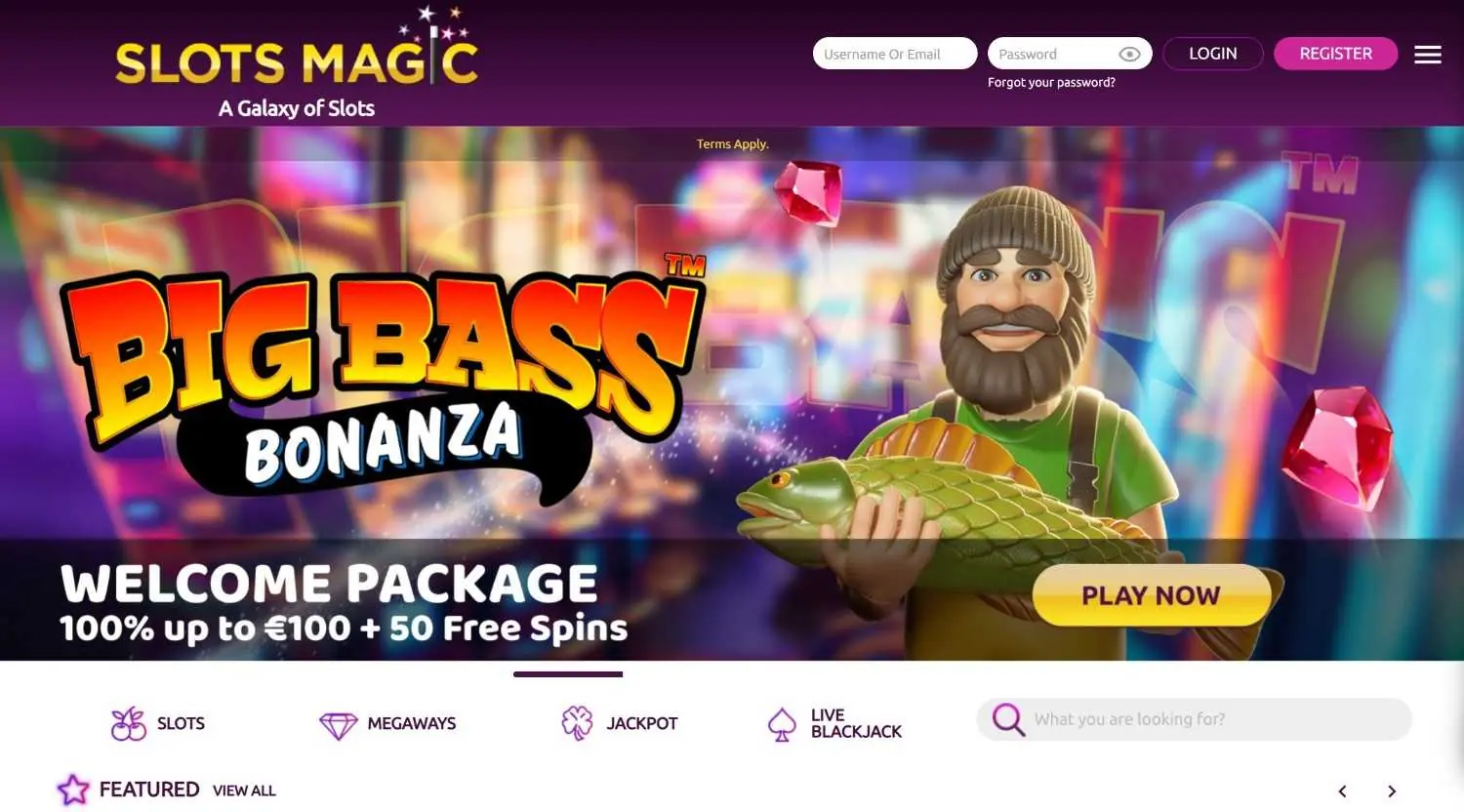
Slots Magic is the slot-led heritage brand in the SkillOnNet network and the most directly comparable PlayOJO alternative for players who prioritise slot inventory curation. The Slots Magic sister sites group includes the same network of UKGC 39326 brands under Skill On Net Ltd. Slots Magic was one of the earlier SkillOnNet UK-facing brands and has been operating on the platform for more than a decade, with a slot-first product structure that distinguishes it from the broader-product PlayOJO or library-deep EU Casino. The brand identity is built around slot curation depth rather than character branding, reflecting the operator’s positioning for slot specialists. Independent affiliate coverage including the Bloody Slots sister sites overview discusses comparable slot-led UKGC operators.
The library carries the SkillOnNet provider stack with particular depth in Pragmatic Play and Play’n GO inventory, alongside NetEnt, Microgaming, Red Tiger, Big Time Gaming, Yggdrasil and Hacksaw Gaming. Slot count runs in the multi-thousands range, comparable to PlayOJO. The live casino offering through Evolution exists but is secondary to the slot focus — players who prioritise live dealer play will find PlayOJO or Spin Genie better matches.
The Slots Magic welcome offer follows the standard SkillOnNet template with wagering capped at 10x under UKGC SR Code 5.1.1 post-19-January-2026. Minimum deposit is £10, maximum bet during wagering is £5 per spin, and bonus funds expire after 7 days. The exact terms depend on the active promotional code.
Payment methods cover the standard SkillOnNet set with e-wallet withdrawals clearing 0–24 hours.
Slots Magic’s distinguishing feature versus PlayOJO is the slot-first product structure and the depth of slot curation. For PlayOJO players who specifically want slot content as the central product rather than the balanced casino-led product PlayOJO offers, Slots Magic is the targeted in-network alternative.
Slots Magic Review
| Metric | The Slots Magic Experience |
|---|---|
| Site Identity | Slot-led heritage brand with slot-first product structure |
| Standout Mechanic | Depth of Pragmatic Play and Play’n GO slot inventory |
| Game Edge | Slot-focused front-end with secondary live casino offering |
| Payout Speed | E-wallets 0–24 hours |
| The Trade-Off | No zero-wagering welcome; live dealer is secondary product |
| Best For | PlayOJO players who want slot content as the central product |
Genting Casino – Heritage PlayOJO Sister Site for Land-Based Crossover
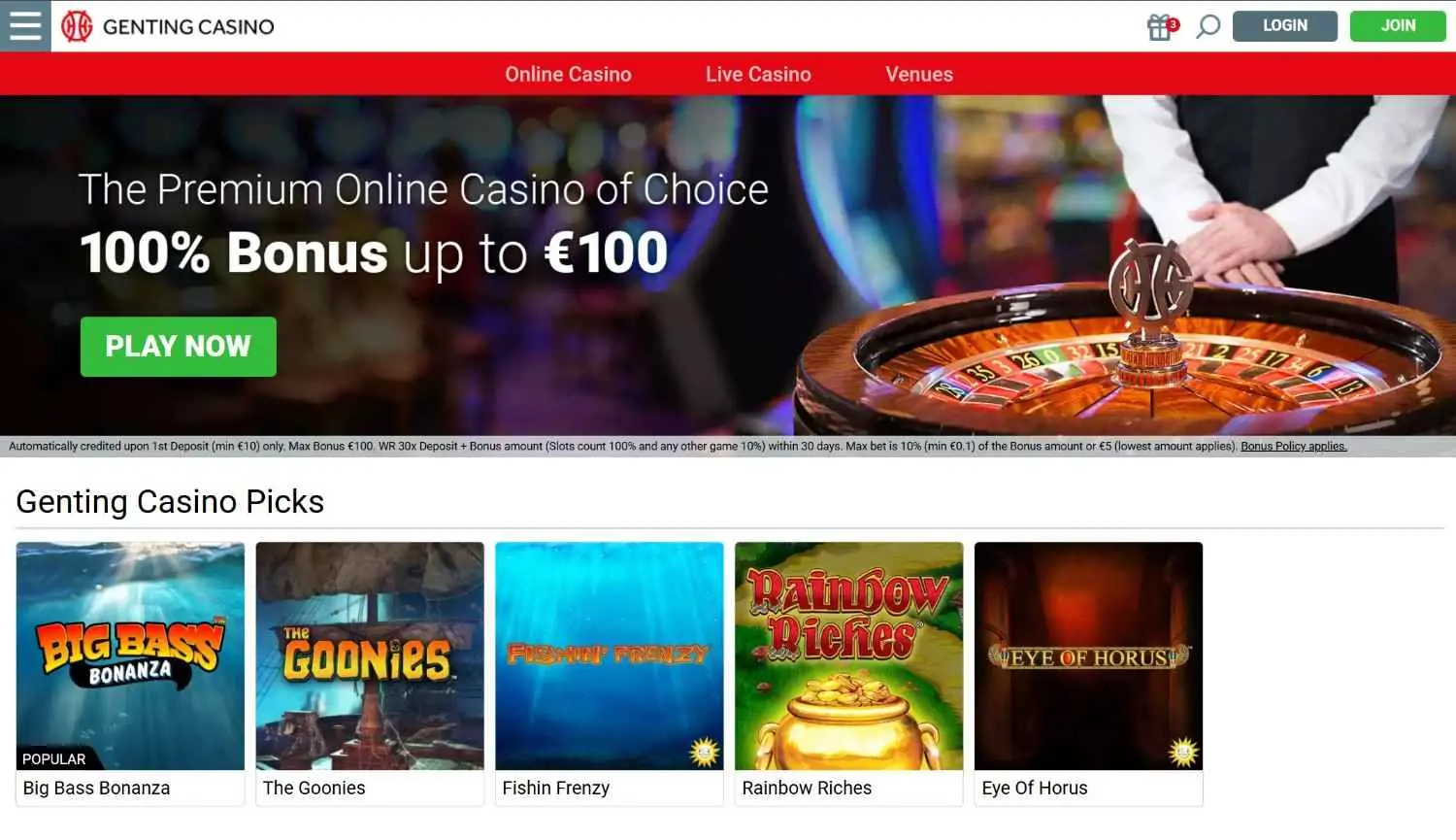
Genting Casino is the land-based heritage brand on the SkillOnNet platform and the most distinctive PlayOJO platform-partner for players who value casino-resort branding. Important licence clarification: although Genting Casino runs on the SkillOnNet platform alongside the directly-licensed SkillOnNet brands, it is operated under a separate UKGC licence (account 54207 per affiliate documentation including gamblingauthority.co.uk, verifiable on the UKGC public register) and as a white-label arrangement between SkillOnNet’s platform infrastructure and Genting UK plc (which provides the brand name and physical-casino heritage from the Genting land-based UK operation). The Genting Casino sister sites group is therefore corporately distinct from the PlayOJO sister sites under Skill On Net Ltd’s 39326 licence, even though the platform technology and several operational integrations are shared. The brand carries a unique Genting Live integration where players can join live dealer tables streamed from Genting’s physical UK casino floors, which is not available at PlayOJO or any directly-licensed SkillOnNet sibling. Independent affiliate coverage including the Captain Spins alternatives guide discusses comparable land-based-heritage UKGC brands.
The casino library carries the standard SkillOnNet provider stack: Pragmatic Play, Play’n GO, NetEnt, Microgaming, Red Tiger, Big Time Gaming, Yggdrasil and Hacksaw Gaming on slots, with Evolution Gaming for the wider live dealer rooms plus the proprietary Genting Live studio for the land-based crossover tables. Slot count runs in the low-to-mid thousands range, smaller than PlayOJO. The land-based-style table game presentation at Genting Live distinguishes the brand from purely online operators including PlayOJO.
The Genting Casino welcome offer follows the SkillOnNet template with a deposit match plus free-spin component, with wagering capped at 10x under UKGC SR Code 5.1.1 post-19-January-2026. Minimum deposit is £10, maximum bet during wagering is £5 per spin, and bonus funds expire after 7 days. The exact terms depend on the active promotional code.
Payment methods follow the SkillOnNet standard. E-wallet withdrawals process within 0–24 hours. Customer support is shared with the rest of the SkillOnNet network. Genting Rewards loyalty mechanics tie online play to the wider Genting UK physical-casino loyalty programme, which is a structural benefit for players who also visit Genting’s land-based UK venues.
Genting Casino’s distinguishing feature versus PlayOJO is the land-based crossover positioning and the Genting Live studio, and although it is not technically a directly-licensed PlayOJO sister site under the 39326 licence, the platform-partner relationship means Genting Casino functions in practice as a closely-related sibling experience. For PlayOJO players who value casino-resort heritage and the Genting Rewards cross-channel integration with physical UK casinos, this is the most thematic platform-partner alternative.
Genting Casino Review
| Metric | The Genting Casino Experience |
|---|---|
| Site Identity | Land-based heritage brand with white-label SkillOnNet platform |
| Standout Mechanic | Genting Live tables streamed from physical UK casino floors |
| Game Edge | Land-based-style table game presentation plus Genting Rewards cross-channel loyalty |
| Payout Speed | E-wallets 0–24 hours |
| The Trade-Off | Smaller slot library than PlayOJO; no zero-wagering welcome |
| Best For | Players who value casino-resort heritage and Genting Rewards integration |
Slingo – Slingo-Format Specialist PlayOJO Sister Site

Slingo rounds out the major SkillOnNet brands profiled here and the most distinctively niche PlayOJO sister site by product specialism. The Slingo sister sites group operates under the same UKGC account 39326 as PlayOJO, Spin Genie, EU Casino, Slots Magic and the broader directly-licensed SkillOnNet portfolio (Genting Casino sits on the SkillOnNet platform as a white-label partner under its own separate UKGC licence). Slingo.com is the original slingo-format website — the brand has been operated by SkillOnNet for several years and houses the largest first-party slingo inventory in the UK casino market. Where PlayOJO offers slingo titles as one category among many, Slingo positions slingo content as the central product.
The library carries the standard SkillOnNet slot inventory drawn from Pragmatic Play, Play’n GO, NetEnt, Microgaming, Red Tiger, Big Time Gaming, Yggdrasil and Hacksaw Gaming, alongside the largest first-party Slingo Originals title set on the SkillOnNet platform. Slingo Originals titles including Slingo Rainbow Riches, Slingo Starburst, Slingo XXXtreme, Slingo Reel King and Slingo Britain’s Got Talent are placed prominently in the front-end. Live casino is available through Evolution but is genuinely secondary to the slingo positioning. The brand’s identity is the strongest niche product in the SkillOnNet stable. Independent affiliate coverage including the Buzz Bingo sister sites guide discusses comparable niche-format UKGC products.
The Slingo welcome offer is structured around slingo-format games with wagering capped at 10x under UKGC SR Code 5.1.1 post-19-January-2026. Minimum deposit is £10, maximum bet during wagering is £5 per spin, and bonus funds expire after 7 days. Free spin winnings credited as bonus funds remain subject to the same wagering before withdrawal.
Payment methods cover the standard SkillOnNet set: Visa Debit, Mastercard Debit, PayPal, Apple Pay, Trustly, Skrill, Neteller, MuchBetter and Paysafecard. Trustly withdrawals can process instantly, with e-wallets clearing 0–24 hours.
Slingo’s distinguishing feature versus PlayOJO is the slingo-format curation depth. For PlayOJO players who specifically want slingo titles as the central product rather than one category among many, Slingo is the most targeted in-network alternative.
Slingo Review
| Metric | The Slingo Experience |
|---|---|
| Site Identity | Original slingo-format website with deepest slingo catalogue in the network |
| Standout Mechanic | Largest first-party Slingo Originals inventory on the SkillOnNet platform |
| Game Edge | Slingo XXXtreme, Slingo Reel King and Slingo Rainbow Riches placed prominently |
| Payout Speed | Trustly instant; e-wallets 0–24 hours |
| The Trade-Off | Thinner pure-slot and live-dealer focus than PlayOJO |
| Best For | Slingo specialists who want the format as the central product |
Our Testing Process: Deposits, Withdrawals and Gameplay
This PlayOJO casino review and the sister site profiles above are grounded in real-money testing across the SkillOnNet network. We opened fresh accounts on each accessible UKGC-licensed platform, deposited between £20 and £100 using a mix of Visa Debit, PayPal, Trustly and Apple Pay, completed KYC verification on each brand, and ran a standardised game selection across slots, blackjack and live roulette. We then requested withdrawals at both small (£50) and mid-range (£500) thresholds and timed processing from request to bank or wallet arrival. Live chat was tested at three time-of-day intervals (morning, late afternoon, late evening) with a standard verification query to measure response times across the shared SkillOnNet support infrastructure. We additionally tested the OJOplus cashback mechanic at PlayOJO specifically to verify how the per-spin cashback applies to slots, table games and live dealer play across an extended session.
Key Differences Between PlayOJO and Its Sister Sites
This PlayOJO review surfaces clear differences across the SkillOnNet network despite the shared UKGC licence and platform. PlayOJO itself runs as the network outlier on bonus structure — the only structurally zero-wagering welcome on the entire SkillOnNet UKGC licence and the only brand with OJOplus cashback applied to every spin across slots, tables and live dealer play. The PlayOJO sister sites in the wider network each carry their own distinctive positioning. Spin Genie brings modern minimalist design and a larger 5,000+ catalogue. EU Casino offers 6,000+ games and the broadest currency range. Slots Magic provides slot-led curation depth. Genting Casino delivers the land-based heritage crossover with Genting Live tables. Slingo specialises entirely in slingo-format content. The sister sites of PlayOJO directly licensed under Skill On Net Ltd account 39326 and the broader PlayOJO casino sister casinos share the same UKGC infrastructure, with Genting Casino operating as a separately-licensed platform partner on the same SkillOnNet technology, and each brand serves a different player type within the wider group of sites like PlayOJO.
Bonus value differs structurally across the SkillOnNet stack because PlayOJO operates on a fundamentally different model from every other brand on the licence. The 19 January 2026 UKGC SR Code 5.1.1 10x wagering cap applies to every SkillOnNet brand with wagering attached to welcome bonuses — meaningfully more favourable than the 30x-60x ranges that applied at the same operators in 2024 and earlier. PlayOJO’s zero-wagering welcome and OJOplus mechanic predate the cap by nine years and remain structurally more generous than even the post-cap wagering-attached offers at the network siblings. The PlayOJO sister sites no deposit bonus picture varies by brand — EU Casino regularly offers a 5-spin Fire Joker no-deposit promotion with a £30 conversion cap, while PlayOJO’s standing welcome is effectively a no-wagering free-spin offer that does not require deposit-first activation in some campaign variants.
Loyalty quality is broadly consistent across the wagering-attached SkillOnNet brands because they share backend infrastructure, payment processing and the SafeMate responsible gambling tool. PlayOJO is the outlier with the OJOplus cashback mechanic that applies network-wide rather than just at higher VIP tiers — this is a structural differentiator and not just a presentation difference. Status does not transfer between brands. The shared KYC infrastructure does propagate flags across the network. Independent affiliate coverage including the Volcano Casino alternatives overview documents similar shared-platform patterns at other UKGC operators.
New SkillOnNet Sister Sites in 2026
Skill On Net Ltd has continued to expand its UKGC 39326 portfolio at a steady cadence, with several new brand launches and rebrands during 2025 and into 2026. The most prominent sister sites of PlayOJO in mid-2026 remain the well-established brands — Spin Genie, EU Casino, Slots Magic, Genting Casino, Slingo, Metal Casino, Play Jango, Lord Ping, Ice36, Megaways Casino, Luna Casino, AHTI Games, Turbonino, Masked Singer Games and Lucky Vegas — alongside more than twenty other brands on the network. There are no PlayOJO sister companies operating outside the Skill On Net Ltd UKGC licence at the time of this PlayOJO casino review. New brand launches under SkillOnNet are added through the operator’s portfolio strategy rather than through white-label arrangements with third parties (with the exception of the Genting Casino white-label relationship); the broader SkillOnNet group operates more than fifty Skill On Net casinos globally across its UKGC and MGA-licensed footprints.
Payment Methods Comparison
| Payment Method | Min Deposit | Max Deposit | Withdrawal Time | Fees |
|---|---|---|---|---|
| Visa Debit (credit cards not permitted per UKGC 14 April 2020 ban) | £10 | £10,000 | 1–5 business days | None |
| Mastercard Debit | £10 | £10,000 | 1–5 business days | None |
| PayPal | £10 | £5,500 | 0–24 hours | None |
| Apple Pay | £10 | £5,500 | 0–24 hours | None |
| Trustly | £10 | £10,000 | Instant to 24 hours | None |
| Skrill / Neteller | £10 | £5,500 | 0–24 hours | None |
| MuchBetter | £10 | £5,500 | 0–24 hours | None |
| Paysafecard | £10 | £1,000 | Not available for withdrawal | None |
| Bank Transfer | £20 | £25,000 | 2–5 business days | None |
Credit cards are not accepted at any UKGC-licensed SkillOnNet brand because UK gambling regulations have prohibited credit card gambling at UKGC-licensed operators since 14 April 2020. Trustly is the strongest withdrawal method for speed with instant-to-24-hour processing on most withdrawals. PayPal and e-wallets typically clear within 24 hours post-KYC. PlayOJO has historically been one of the faster brands in the SkillOnNet network on withdrawal processing — the brand’s award-winning reputation for player service is built partly on consistent payout speed. Independent affiliate coverage including the Casushi sister sites overview discusses comparable UKGC banking patterns.
Game Providers at PlayOJO Sister Sites
| Site | Top 5 Providers | Approx. Game Count | Live Dealer Available |
|---|---|---|---|
| PlayOJO | Pragmatic Play, Play’n GO, NetEnt, Microgaming, Red Tiger | ~3,000 | Yes (Evolution) |
| Spin Genie | Pragmatic Play, Play’n GO, NetEnt, Microgaming, Hacksaw Gaming | 5,000+ | Yes (Evolution) |
| EU Casino | Pragmatic Play, Play’n GO, NetEnt, Microgaming, Yggdrasil | ~6,000 | Yes (Evolution) |
| Slots Magic | Pragmatic Play, Play’n GO, NetEnt, Microgaming, Red Tiger | ~3,000+ | Yes (Evolution) |
| Genting Casino | Pragmatic Play, Play’n GO, NetEnt, Microgaming, Red Tiger | ~2,000 | Yes (Evolution + Genting Live) |
| Slingo | Slingo Originals, Pragmatic Play, Play’n GO, Hacksaw Gaming, Red Tiger | ~1,500 (slingo focus) | Yes (Evolution) |
Provider overlap is significant across the SkillOnNet network because every brand draws from the same shared content aggregation layer. Pragmatic Play, Play’n GO, NetEnt and Microgaming anchor the slot inventory at every brand, with Red Tiger, Big Time Gaming, Yggdrasil, Hacksaw Gaming, Quickspin and ELK Studios rounding out the slot stack. Evolution Gaming is the live dealer studio across the entire network. The clearest differentiators are at the edges: EU Casino runs the broadest provider list at 50+ studios; Slingo carries the largest Slingo Originals first-party inventory; Genting Casino has the unique Genting Live studio for land-based-style live tables; and PlayOJO carries the most awarded mainstream curation supported by the OJOplus cashback structure. Independent comparison resources including the Caswino alternatives overview discuss comparable shared-provider UKGC networks.
Live Casino at SkillOnNet Sites
Live dealer coverage across the SkillOnNet network runs through Evolution Gaming as the primary studio at every brand. Standard tables include European, American and French roulette, multi-tier blackjack rooms, baccarat and the full Evolution game-show inventory covering Crazy Time, Lightning Roulette, Monopoly Live, Dragon Tiger, Mega Wheel, Sweet Bonanza Candyland and Cash or Crash. Table limits start around £0.50 and run up to £5,000 per hand on VIP tables across the network. PlayOJO additionally extends its OJOplus cashback to live dealer play, which means every hand or spin at a live table generates per-action cashback — a mechanic that is unique to PlayOJO and not available at any other SkillOnNet brand. Genting Casino offers the proprietary Genting Live studio with tables streamed from Genting’s physical UK casino floors, which is the other unique live-casino differentiator within the network.
Mobile Experience Across Sister Sites
None of the SkillOnNet brands offer dedicated iOS or Android native apps including PlayOJO — mobile play runs entirely through the responsive browser version on each brand’s domain. Browser performance is consistent across the network and loads quickly on mid-range devices. The absence of native apps is a structural network constraint — SkillOnNet has historically prioritised platform consistency over app development.
VIP and Loyalty Programmes
PlayOJO’s loyalty positioning is the network outlier: the OJOplus mechanic applies cashback to every spin on every game (slots, tables, live dealer) for every player at every tier, rather than reserving cashback benefits for higher VIP tiers as is typical at other UKGC operators including the other SkillOnNet siblings. This is a structural differentiator that materially affects long-term return-to-player economics for active accounts. Spin Genie, EU Casino, Slots Magic, Genting Casino and Slingo all run tier-based loyalty programmes with cashback at higher tiers, faster withdrawal processing at the top end and dedicated VIP account management for the highest tiers — the standard UKGC loyalty model rather than PlayOJO’s universal cashback structure. Loyalty status does not transfer between brands. The shared KYC infrastructure does synchronise flags across the network. Independent affiliate coverage including the Fluffy Wins sister sites overview documents similar non-portable-loyalty patterns at comparable UK multi-brand operators.
Features These Casinos Lack
The SkillOnNet network has gaps that prospective PlayOJO players should weigh honestly. Native iOS and Android apps are not offered anywhere in the network — mobile play is browser-only across every brand including PlayOJO. Loyalty status is not portable between brands, requiring fresh tier progression at each sibling. Welcome bonus value at UKGC-licensed brands is materially smaller than at non-UK SkillOnNet products operating under the MGA licence, reflecting the post-2025 UK regulatory environment including the 10x wagering cap effective 19 January 2026 (although PlayOJO’s zero-wagering structure sidesteps this constraint entirely). The shared KYC infrastructure that propagates verification flags across the network can be slow to resolve documentation friction. PlayOJO’s slot library, while exceptionally well-curated, is materially smaller than EU Casino’s 6,000+ catalogue or Spin Genie’s 5,000+ — players who prioritise raw library breadth may find PlayOJO constraining.
Safety, Licensing and Regulation — GamStop Status
Skill On Net Ltd holds UK Gambling Commission account 39326 and is registered with GamStop, the UK self-exclusion scheme. Players who self-exclude through GamStop will have their accounts closed across every SkillOnNet brand including PlayOJO, Spin Genie, EU Casino, Slots Magic, Genting Casino, Slingo and the rest of the network. The full UKGC public register entry confirms the licence is active with remote casino, bingo and gaming software authorisations. The Skill On Net Ltd registered address is Level 5, Quantum House, 75 Abate Rigord Street, Ta’Xbiex, 1120, Malta.
Skill On Net Ltd has one recorded UKGC enforcement action on the public register that prospective UK players should weigh as part of the overall picture. In May 2023, the UKGC imposed a financial penalty of £305,150 plus £9,079 costs against Skill On Net Ltd, alongside a mandated third-party audit condition, for anti-money laundering and social responsibility failures during the period January 2021 to December 2022. The Commission found that SkillOnNet had permitted customers to lose materially more than the operator’s internal £2,000 limit on “recycling” assumptions about repeat deposits, had applied insufficient AML risk profiling, had relied excessively on customer declarations for source-of-funds rather than independent verification, and had not produced the required annual AML officer report. The fine applied to the entire 39326 operator licence, meaning the conduct findings cover the period when PlayOJO, EU Casino, Spin Genie, Slots Magic, Slingo and the directly-licensed SkillOnNet brands were operating under account 39326, and the third-party audit remediation conditions extend across every brand on that licence. Genting Casino, as a separate-licence white-label partner on the SkillOnNet platform, is not directly covered by this May 2023 settlement (which applies to Skill On Net Ltd’s own 39326 licence) but does share the underlying platform infrastructure that was remediated. SkillOnNet accepted the findings and cooperated with the regulator on remediation, which the UKGC took into account as mitigating factors. No further UKGC enforcement actions have been recorded against Skill On Net Ltd since the May 2023 settlement at the time of this PlayOJO casino review.
Skill On Net Ltd is also licensed by the Malta Gaming Authority for international markets, by Spelinspektionen in Sweden, and by Spillemyndigheden in Denmark. The multi-jurisdictional licensing creates additional oversight. Each brand uses SSL encryption for player data, KYC verification before withdrawal, AML protocols compliant with UKGC requirements, and full responsible gambling tool integration including deposit limits, time-outs, reality checks, GamStop self-exclusion and the SkillOnNet-exclusive SafeMate behavioural monitoring tool (which alerts players to changes in transaction patterns and time-on-site via email or phone). Random number generators are certified by iTech Labs.
| Site | Licence Body | Licence Holder | Responsible Gambling Tools | RNG Testing |
|---|---|---|---|---|
| PlayOJO | UKGC 39326 + MGA | Skill On Net Ltd | Deposit limits, time-out, reality checks, GamStop, SafeMate | iTech Labs certified |
| Spin Genie | UKGC 39326 + MGA | Skill On Net Ltd | Deposit limits, time-out, reality checks, GamStop, SafeMate | iTech Labs certified |
| EU Casino | UKGC 39326 + MGA | Skill On Net Ltd | Deposit limits, time-out, reality checks, GamStop, SafeMate | iTech Labs certified |
| Slots Magic | UKGC 39326 + MGA | Skill On Net Ltd | Deposit limits, time-out, reality checks, GamStop, SafeMate | iTech Labs certified |
| Genting Casino | UKGC 54207 (separate licence; SkillOnNet platform partner) | Genting UK plc / Prime Gaming (white-label with SkillOnNet platform) | Deposit limits, time-out, reality checks, GamStop | Independent lab certified |
| Slingo | UKGC 39326 + MGA | Skill On Net Ltd | Deposit limits, time-out, reality checks, GamStop, SafeMate | iTech Labs certified |
Dispute resolution for UK players runs through the UKGC’s listed alternative dispute resolution (ADR) providers. Players who cannot resolve a complaint directly can escalate through the operator’s named ADR provider and ultimately to the UKGC itself for licence-condition breaches. The Independent Betting Adjudication Service (IBAS) is the named ADR for several SkillOnNet brands. Players are encouraged to seek responsible gambling support through the resources listed at the close of this guide.
Common Complaints and Issues
PlayOJO consistently scores among the highest of all UKGC-licensed brands on independent player feedback platforms, with the OJOplus cashback mechanic and zero-wagering welcome the two most-praised structural features. The most consistent constructive criticism centres on the relatively curated slot library size (around 3,000 titles) versus larger competitors at 5,000-6,000+ titles — players who explicitly prioritise raw library breadth occasionally find PlayOJO constraining despite the better bonus economics. Some long-running PlayOJO players also note that the OJOplus per-spin cashback values are relatively modest individually (typical rates are fractional percentages per spin), and that the cumulative benefit only becomes meaningful at higher play volumes.
The non-portability of loyalty status across the network is another recurring complaint — a high-tier PlayOJO player has to start fresh at any sister site within the SkillOnNet family. The mandatory KYC verification before first withdrawal is standard at all UKGC-licensed operators. The browser-only mobile experience can frustrate players who prefer app-based gameplay, although PlayOJO’s responsive mobile browser is among the better-performing in the SkillOnNet network. The May 2023 UKGC enforcement action against the operator covers the period when PlayOJO was operating, and represents a real consideration for players weighing PlayOJO against alternatives.
What Users Say
| Source | What Players Praise | What Players Criticise |
|---|---|---|
| Independent player forums (PlayOJO) | Zero-wagering welcome; OJOplus cashback on every spin; 15+ industry awards; consistently high independent review scores | Smaller headline library than EU Casino or Spin Genie; OJOplus per-spin values modest individually |
| Independent player forums (Spin Genie) | Modern minimalist interface; 5,000+ titles; cleaner front-end than older network brands | No zero-wagering welcome; standard SkillOnNet bonus structure |
| Independent player forums (EU Casino) | Broadest library in the network (6,000+ games); multi-currency support; Fire Joker no-deposit spin offer | Generic brand positioning lacks personality; no OJOplus equivalent |
| Independent player forums (Slots Magic) | Slot-led curation depth; consistent platform performance; established brand history | Live dealer secondary to slot focus; no zero-wagering welcome |
| Independent player forums (Genting Casino) | Genting Live tables from physical UK casinos; Genting Rewards cross-channel integration; land-based heritage | Smaller slot library than EU Casino or Spin Genie; no zero-wagering welcome |
| Independent player forums (Slingo) | Deepest slingo-format catalogue; Slingo Originals titles; niche specialism done well | Thinner pure-slot focus than PlayOJO |
Overall sentiment across the SkillOnNet network places PlayOJO consistently at the top of the network and frequently at the top of UKGC operator rankings on independent review aggregators. The structural advantage of the zero-wagering welcome and OJOplus cashback is the primary driver. The May 2023 UKGC enforcement action against Skill On Net Ltd disclosed in the Safety section is a real consideration for players evaluating any brand under account 39326, although PlayOJO’s operational track record on customer service and payout speed has remained strong throughout.
Bonus and Wagering Requirements at PlayOJO Sister Sites
The PlayOJO welcome offer is structurally zero-wagering — new players receive 50 free spins on Book of Dead with winnings paid as cash with no wagering attached, in contrast to every other SkillOnNet brand where the post-19-January-2026 UKGC SR Code 5.1.1 10x wagering cap applies but wagering still exists. A worked example for the PlayOJO welcome: deposit £10 (the minimum) with a qualifying debit card, PayPal or Trustly transfer, receive 50 free spins on Book of Dead at the standard spin value (verify current spin value on cashier). Free spin winnings are credited directly as cash with no wagering required to clear. For example, if 50 spins generate £20 in winnings, £20 is immediately withdrawable subject only to standard KYC verification — there are no further wagering steps required. This is structurally different from every other SkillOnNet welcome which now operates under the 10x bonus-wagering cap. Maximum bet during wagering is standard at £5 per spin if wagering applies (it does not apply at PlayOJO). The exact spin value and game depend on the active promotional code — confirm on site before depositing because PlayOJO occasionally runs additional time-limited variants alongside the standing zero-wagering welcome.
Wagering across the rest of the SkillOnNet UKGC network is uniformly 10x on bonus funds following the SR Code 5.1.1 cap effective 19 January 2026 — meaningfully more favourable than the 30x-60x ranges that applied at the same operator in 2024 and earlier. Maximum bet during wagering is consistent at £5 per spin across the network. The PlayOJO sister sites no deposit bonus picture is variable; EU Casino regularly runs a 5-spin Fire Joker no-deposit promotion with a £30 conversion cap, while PlayOJO’s own standing welcome is structurally zero-wagering and applies without complex multi-tier conditions.
How to Choose the Right Sister Site
Across this group of sites like PlayOJO and the broader PlayOJO similar sites within Skill On Net Ltd’s network, the PlayOJO sister sites collection each offer different positioning, so the choice comes down to whether the zero-wagering and OJOplus advantages of PlayOJO outweigh the larger libraries or different specialisations at the siblings. Pick PlayOJO if you want the cleanest bonus structure on the entire SkillOnNet licence and the OJOplus cashback on every spin. Pick Spin Genie if you want a modern minimalist interface with comparable or broader library depth. Pick EU Casino if you want the broadest game catalogue and multi-currency support. Pick Slots Magic if you want slot-led curation depth. Pick Genting Casino if you value casino-resort heritage and the Genting Live land-based crossover. Pick Slingo if you specifically want slingo-format games as the central product.
Which PlayOJO Sister Site Is Best?
Within the Skill On Net network, the best PlayOJO sister site is Spin Genie. Three reasons drive that verdict. First, Spin Genie carries the broadest game library at 5,000+ titles — materially larger than PlayOJO’s catalogue while still drawing from the same shared content aggregation layer. Second, the 2022 launch year means the front-end is the most contemporary in the network with the cleanest interface design. Third, although Spin Genie operates under the standard wagering-attached SkillOnNet template rather than PlayOJO’s zero-wagering structure, the 19 January 2026 UKGC SR Code 5.1.1 cap means even the wagering-attached welcome offers are now meaningfully more favourable than at most UKGC operators outside the network. For PlayOJO players who want a heritage brand with even larger library, EU Casino is the next-best in-network pick.
Outside the SkillOnNet network, comparable UKGC alternatives worth weighing include Mr Q (the most directly comparable UKGC operator for wager-free welcome positioning, sharing PlayOJO’s editorial philosophy on bonus simplicity) and Mr Vegas (a comparable high-volume UK operator with strong slot library curation and around 5,500 titles). Both operate independently of the SkillOnNet shared infrastructure and may suit PlayOJO players who want a different operator family while retaining bonus structure preferences. Whichever path you choose, complete your KYC verification immediately after registration. Submit ID, address proof and a payment-method proof in the first session rather than waiting for the withdrawal stage, because verification friction at withdrawal time is the most common operational complaint across the SkillOnNet network and pre-emptive KYC removes most of the risk. Test a small withdrawal before depositing larger amounts.
If you ever feel that gambling is becoming a problem, please reach out for free, confidential support through GamCare on 0808 8020 133, consider self-exclusion via GamStop (which covers every UKGC-licensed Skill On Net brand), or visit GambleAware for tools and guidance. 18+ only.